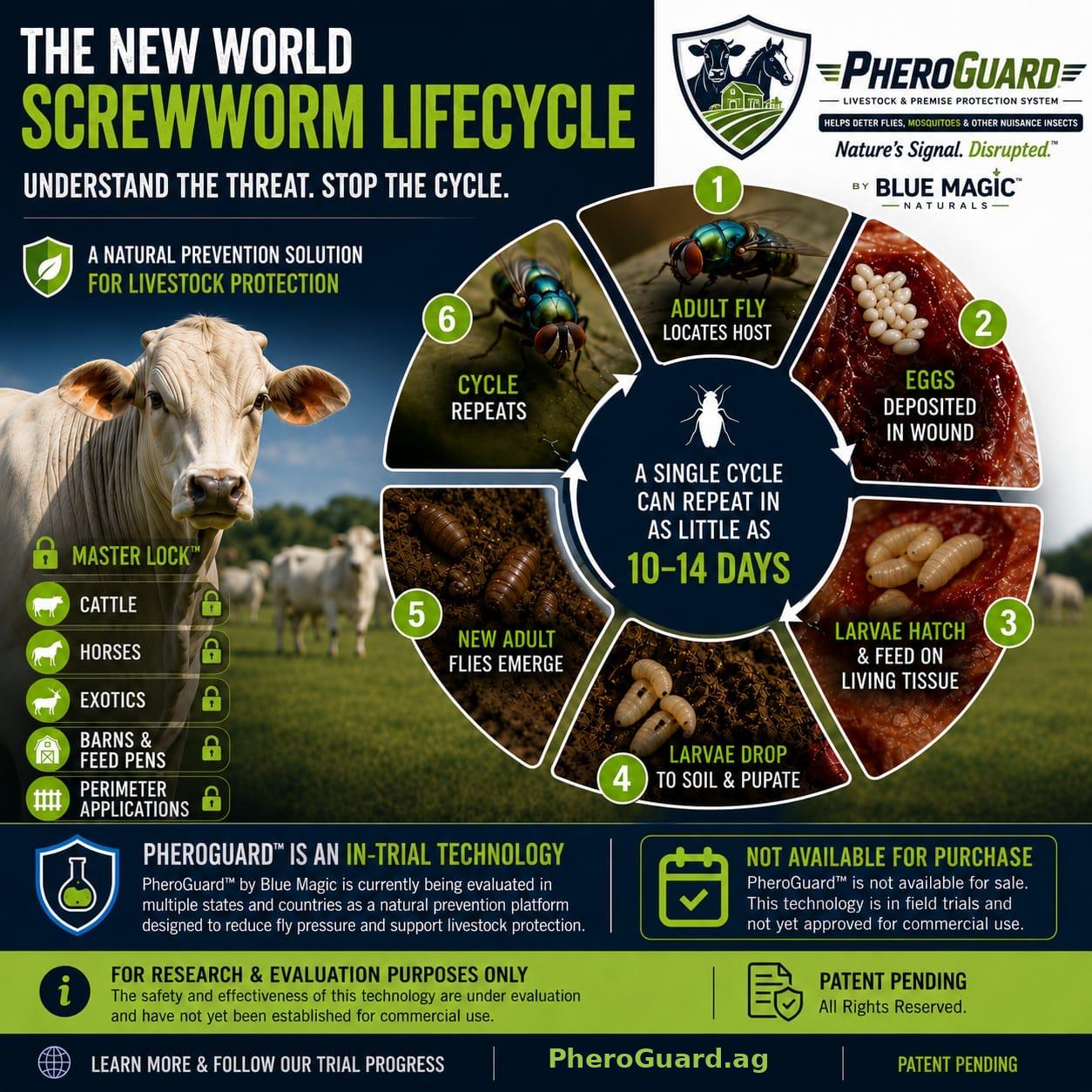
Life Cycle · ~18–24 Day Total
A small fly. A big threat.
Females lay 100–400 eggs around the edge of wounds — up to 2,000–3,000 in a lifetime. PHEROGUARD targets the stages where intervention matters most.
1
Adult Fly
Lives 2–3 weeks
Metallic blue-green flies seek out fresh wounds to lay eggs.
2
Egg
12–24 hours
Eggs laid around wounds; hatch within a day.
3
Larval
5–7 days
Larvae burrow into living flesh and feed aggressively.
4
Pupal
7–60 days
Mature larvae drop to soil and form a pupal case.
5
Emergence
3–5 days
Adults emerge, mate, and the cycle begins again.
Three Layers, Mapped to the Cycle
Interrupt the behavior at every stage.
Layer 1 · Topical → Egg Stage
Ointment + Silver Shield Spray
Topical care for wounds & surgical sites — the exact entry points where females lay eggs.
Layer 2 · Spray → Adult Fly Stage
Spray Concentrate
Disrupts host-seeking & landing on animals and facilities — before flies reach a wound.
Layer 3 · Granules → Larval & Pupal
Perimeter Granules
Treats soil & high-pressure zones where larvae drop and pupae develop — breaking the cycle.