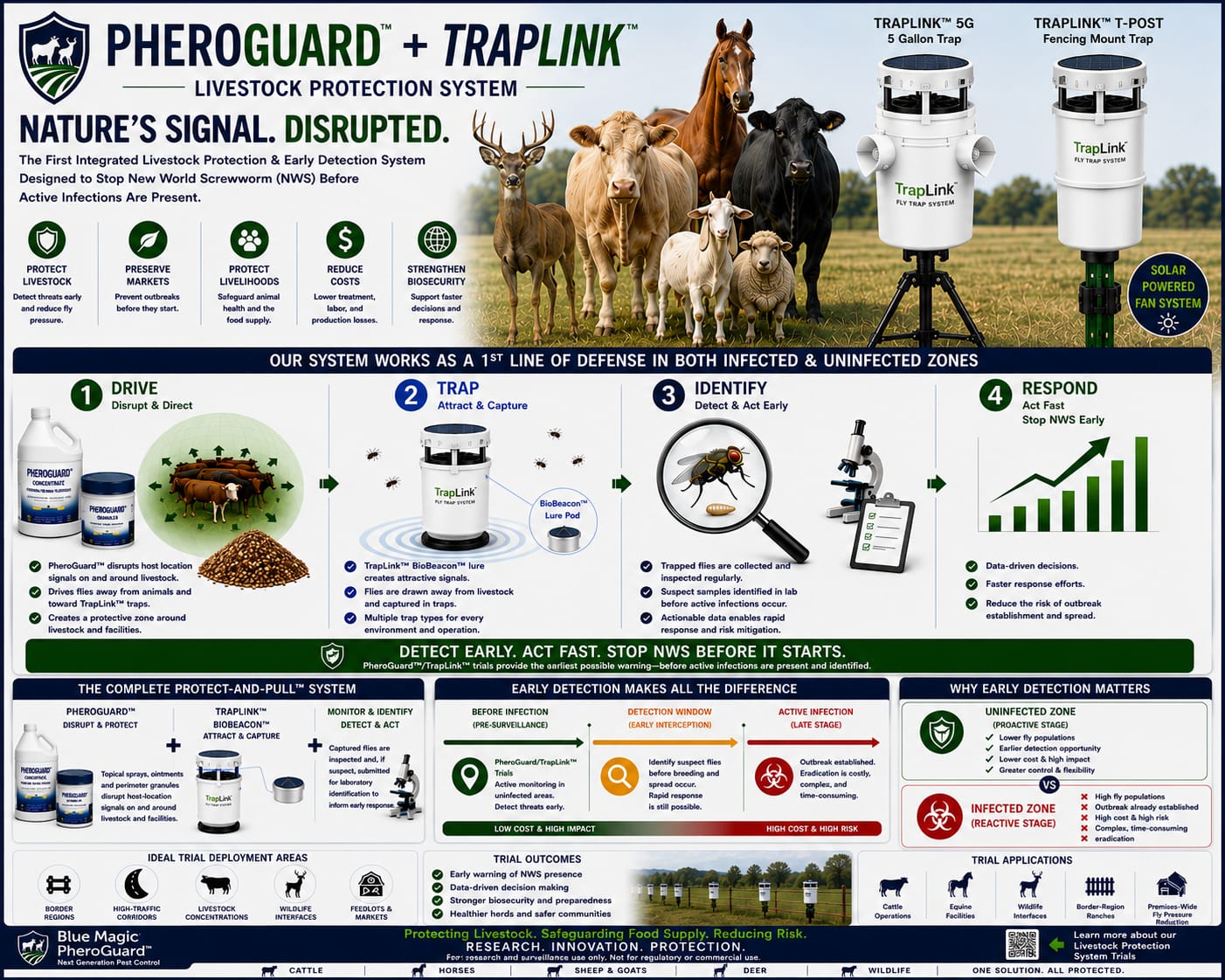
TrapLink™ is the intelligent surveillance half of the PheroGuard™ Livestock Protection System — a solar-powered, AI-assisted sentinel built to detect New World Screwworm flies in the environment before active infestations take hold.
PheroGuard pushes flies away from your animals. TrapLink pulls them in, identifies them, and tells you the moment a threat appears. Together they form a continuous first line of defense across both infected and uninfected zones.
Topical sprays, ointments and perimeter granules disrupt host-location signals on and around livestock and facilities — driving flies away from your animals and toward the trap line.
Solar-powered sentinel stations attract, capture and photograph flies, then use an onboard AI screening engine to flag probable New World Screwworm and alert your team for expert review.
DETECT EARLY · ACT FAST · STOP NWS BEFORE IT STARTS
Four stages take you from disruption to data-driven response — the earliest possible warning, before active infections are present and identified.
PheroGuard™ disrupts host-location signals, driving flies away from animals and toward the trap line — creating a protective zone around livestock and facilities.
The TrapLink™ BioBeacon™ lure creates species-specific attractive signals. Flies are drawn away from livestock and captured, with multiple trap types for every environment.
An integrated camera images each insect and the onboard AI classifies probable New World Screwworm — flagging suspect specimens before active infections occur.
Suspect detections trigger automated alerts to a cloud dashboard or mobile app for expert review — enabling data-driven decisions and rapid, targeted response.
Each TrapLink station integrates targeted attraction, autonomous power, machine vision and artificial intelligence into a single field-deployable platform.
A species-specific lure engineered to attract target blowflies and related pest species toward the monitoring station.
Continuous field deployment with minimal maintenance — a self-sufficient sentinel that runs unattended in remote locations.
Automatically captures standardized images of insects entering or interacting with the station for consistent, comparable analysis.
Evaluates captured imagery and classifies insects into target groups — including probable New World Screwworm — while distinguishing common non-target species.
Configure each station around your surveillance objective — preserve physical specimens for lab confirmation, or run a non-lethal continuous monitoring station.
Insects are retained on adhesive monitoring cards or other capture media, enabling AI-assisted identification while preserving physical specimens.
A non-lethal intelligent monitoring station. Flying insects are photographed and analyzed by the onboard AI as they pass through the imaging chamber, then exit.
Two solar-powered, fan-driven trap bodies cover ground-level placement and fence-line deployment across ranches, feedyards and border regions.
A solar-powered, fan-driven 5-gallon trap body for high-capacity ground placement at feedlots, facilities and livestock concentrations.
A fence-line mounted unit for perimeter and border deployment — ideal for high-traffic corridors, wildlife interfaces and ranch boundaries.
As the TrapLink network expands, every captured image strengthens the AI — building a living library of insect abundance, seasonal activity, migration patterns and geographic distribution.
From intelligent trapping to intelligent surveillance — the future of livestock biosecurity begins before the first infestation is found.
Inquire About the Trial Program →